Understand the obligations that follow your chemicals through every use

What a material contains, how it is used, and where it is supplied all matter. Investigate registration, hazard communication, handling, and disposal requirements with sources you can examine.

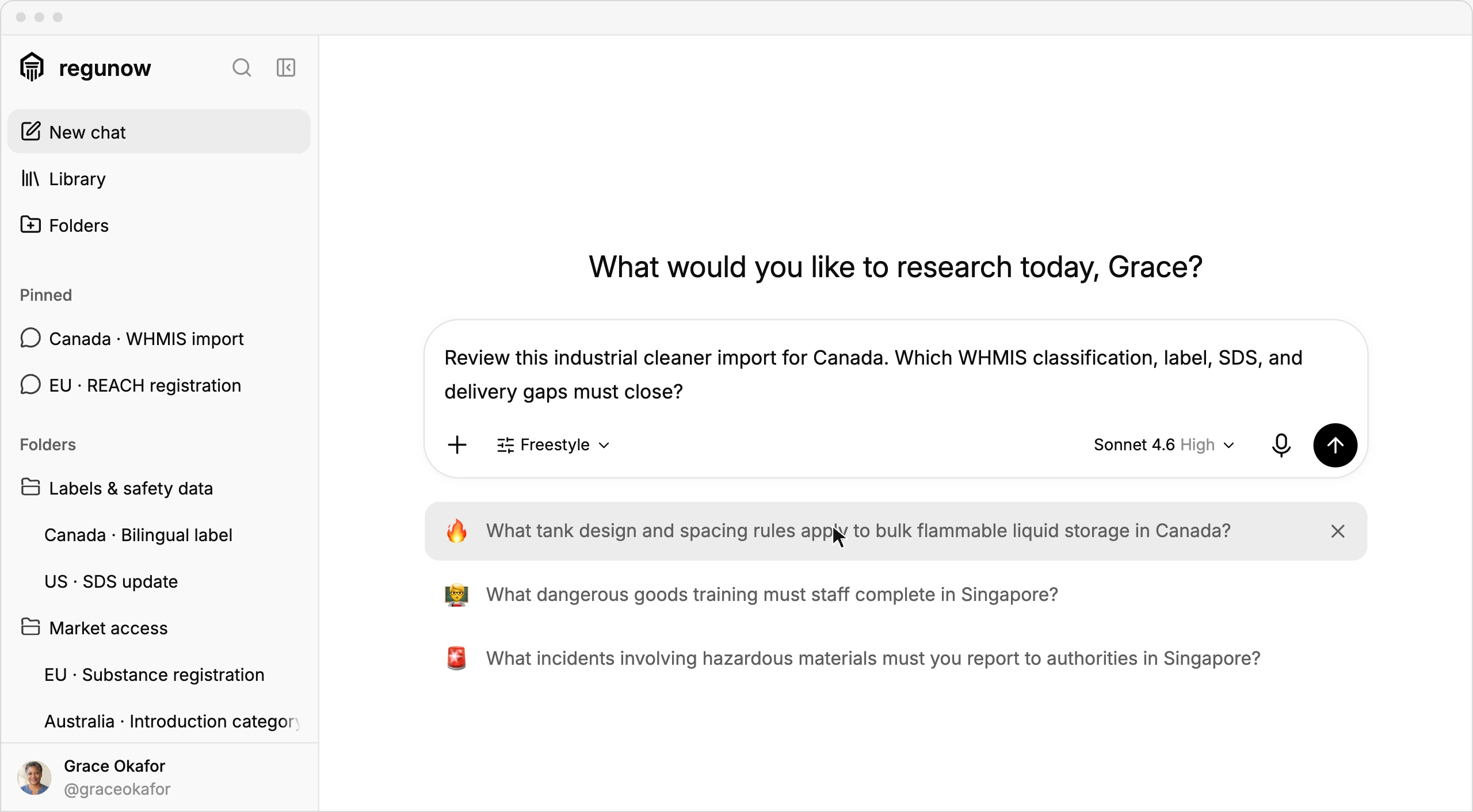
Preview of the Regunow regulatory research workspace

Chemical controls from supply to disposal

  • European Union: REACH
  • United States: TSCA
  • South Korea: K-REACH
  • Canada: WHMIS
  • Australia: AICIS
  • China: New-chemical registration
  • Japan: CSCL
  • India: MSIHC Rules
  • United Kingdom: COSHH
  • Switzerland: Chemicals Act
  • Brazil: Chemical inventory law
  • Vietnam: Chemicals Law
  • Indonesia: B3 controls
  • Saudi Arabia: Chemicals import requirements
  • Taiwan: Toxic-chemical controls
  • Hong Kong: Dangerous Goods Ordinance
  • Singapore: Environmental Protection and Management Act
  • United Arab Emirates: Environmental protection law
  • Mexico: NOM-018-STPS
  • European Union: CLP
  • United States: GHS under U.S. HazCom
  • United States: Proposition 65 (California)
  • European Union: Seveso III
  • United Kingdom: COMAH
  • United States: FIFRA
  • European Union: Biocidal Products Regulation
  • European Union: POPs Regulation
  • European Union: Prior Informed Consent Regulation
  • United States: OSHA process safety
  • United States: EPA Risk Management Program
  • United States: Hazardous Materials Regulations
  • Canada: Transportation of Dangerous Goods Act
  • European Union: SVHC under REACH
  • European Union: UFI
  • European Union: RoHS
  • India: Insecticides law
  • Japan: Agricultural Chemicals Regulation Act
  • Canada: Pest Control Products Act
  • South Korea: Chemicals Control Act
  • European Union: Plant Protection Products Regulation
  • European Union: Pyrotechnic Articles Directive
  • European Union: Civil Explosives Directive

Start with the substance, its uses, and your responsibilities

Define the substance or mixture before comparing requirements

For substance manufacturers, formulators, distributors, and importers, the answer depends on composition and use. Research the substance, mixture, concentration, market, and role your business holds.

Examine what the supplier's safety information establishes

Attach a safety data sheet or supplier declaration. Ask how the supplied information relates to retrieved requirements and where identification, classification, or use details are missing.

Follow the material from import and formulation to disposal

Explore the obligations that arise as a chemical is imported, formulated, stored, transported, used, or discarded. Separate market-access rules from workplace, transport, and environmental duties.

Research chemical duties across products, processes, and supply chains

Industrial chemicals

Investigate registration and restrictions before a substance enters a market

Investigate inventories, registration, notification, and restrictions. Compare the questions raised by a new substance, an existing substance, and a new use across the markets you are researching.

Specialty chemicals

Revisit classification and supplier evidence when a formulation changes

Explore how ingredients, concentrations, and intended uses affect coatings, adhesives, dyes, and other formulations. Research classification, restricted substances, and the supporting information needed from suppliers.

Agrochemicals

Explore how an agrochemical claim affects the regulatory category

Examine pesticide, biocide, and treated-article questions using the active substance, application, and intended claim. Research authorization, labeling, and residue obligations for the relevant product category.

Hazardous materials

Connect hazard information with the requirements for a shipment

Work through safety data sheets, hazard communication, transport classification, packaging, and documentation. Distinguish workplace or supply labeling from the rules that apply to a dangerous-goods consignment.

Refining & petrochemicals

Research the process and site duties behind refining operations

Research major-accident prevention, process safety, storage, and emissions around a refining or petrochemical operation. Frame the review around inventories, operating conditions, and responsibilities at the site.

Explosives & pyrotechnics

Clarify permissions for making, storing, and using explosives

Explore manufacture, sale, storage, transport, and use requirements for explosives and pyrotechnic products. Identify the licensing and product-conformity questions that need resolution before an activity proceeds.

Check the requirements for your substance or mixture

Start researching